
Durchfluß-Rotoren
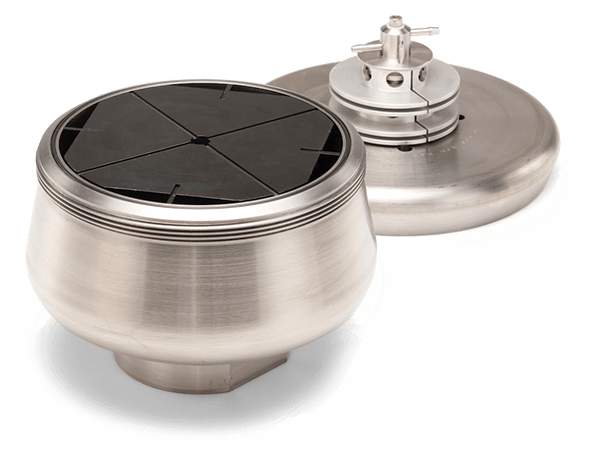
Ein Rotor mit Durchflußrotor ermöglicht es, große Probenmengen bei hohen Zentrifugalkräften zu zentrifugieren, ohne langwieriges Füllen und Dekantieren vieler Zentrifugenröhrchen oder häufiges Starten und Stoppen des Rotors. Wenn Sie diesen Rotor verwenden, sammeln Sie entweder einen Überstand auf oder zentrifugieren sie ein Pellet ab. Rotoren mit kontinuierlichem Durchfluß minimieren die Versuchszeit aus 2 Gründen erheblich:
1) Sie haben kurze Weglängen, um die Gesamtzentrifugierzeit zu reduzieren. Daher pelletieren sie Feststoffe effizient aus einem Probenstrom heraus und ermöglichen einen schnellen Materialfluss durch den Rotor.
2) Sie haben große Kapazitäten. Daher müssen sie nicht so oft gestartet und gestoppt werden wie herkömmliche Rotoren. Dies spart Zeit, da die Probenbearbeitung reduziert wird und die Wartezeit auf die Rotorbeschleunigung/-verzögerung zwischen den Durchläufen verkürzt wird.

Zu den Hauptanwendungen für Durchflußrotoren gehören: große Viren, Mitochondrien, Gewebehomogenate, Bakterien, Zellernte und Algenernte. Es ist am besten, einen Rotor mit kontinuierlichem Fluss zu verwenden, wenn:
- der Sedimentationskoeffizient der zu sammelnden Partikel größer als 50 S ist. Da der Rotor einen hohen Pelletierwirkungsgrad hat, können Feststoffe schneller aus dem flüssigen Medium abgetrennt werden als mit einem Schwingbecher- oder Festwinkelrotor.
- Das Feststoff/Flüssigkeits-Verhältnis der Probe ist niedrig (5-15%). Oberhalb eines Fest/Flüssig-Verhältnisses von 15% neigt der Rotor zu einem zu hohen Wirkungsgrad, d.h. er pelletiert so schnell, dass er sich sofort füllt. Das bedeutet, dass er zum Entladen der Pellets so oft angehalten werden muss, dass zu viel Zeit für das Beschleunigen/Abbremsen des Rotors und die Reinigung zwischen den Läufen verloren geht. Umgekehrt, wenn die Probe wenig Feststoffmaterial enthält, arbeitet der Rotor über lange Zeiträume und verarbeitet zwischen den Abschaltungen große Materialmengen.
FAQ Continuous Flow Centrifuge Rotors
What types of samples can be processed with continuous flow rotors?
Continuous flow rotors can be used for cell cultures, microbial suspensions, viral preparations, fermentation broths, tissue homogenates and other biological samples that require large-volume processing and particle recovery.
Why are continuous flow rotors used for large-scale centrifugation?
Continuous flow rotors help eliminate many of the inefficiencies associated with repeated batch processing. By allowing continuous sample loading and processing, they can significantly improve throughput when handling large sample volumes.
How does a continuous flow centrifuge work?
In a continuous flow centrifuge, the sample is continuously fed into the spinning rotor while clarified liquid exits the system. Particles with sufficient sedimentation properties are retained and concentrated within the rotor, allowing large sample volumes to be processed efficiently.
Why are continuous flow rotors advantageous for dilute samples?
Samples with low solid concentrations allow the rotor to operate for extended periods before unloading is required. This enables continuous processing of large volumes, making the workflow more efficient and reducing downtime.
When should a continuous flow rotor be used?
A continuous flow rotor is best suited for processing large sample volumes that contain relatively low concentrations of solid particles. It is particularly effective when the particles have a sedimentation coefficient greater than 50 S, allowing rapid and efficient separation.
What happens if the solid concentration exceeds 15%?
When the solid-to-liquid ratio is above 15%, pellet formation can occur too quickly, causing the rotor to fill rapidly. This requires frequent stops for pellet removal and cleaning, reducing overall process efficiency due to repeated acceleration and deceleration cycles.
What are the advantages of continuous flow centrifugation?
Continuous flow centrifugation can reduce sample handling, improve throughput, minimize downtime between runs and support efficient processing of large-volume samples. These advantages make continuous flow rotors valuable for scale-up and production-oriented centrifugation workflows.
What is the difference between a continuous flow rotor and a standard centrifuge rotor?
Standard centrifuge rotors process samples in discrete batches using individual tubes or bottles. Continuous flow rotors allow material to be processed continuously while the rotor remains in operation, making them better suited for large-scale centrifugation and high-throughput workflows.
Why is a continuous flow rotor recommended for particles with a sedimentation coefficient above 50 S?
Continuous flow rotors have very high pelleting efficiency. For particles with sedimentation coefficients greater than 50 S, they can separate solids from liquids more quickly than fixed-angle or swinging-bucket rotors, improving throughput and reducing processing time.
What is a continuous flow rotor?
A continuous flow rotor is a centrifuge rotor that allows samples to be continuously introduced and processed while the rotor remains in operation. This design enables efficient processing of large sample volumes without the need for repeated centrifuge tube loading and unloading.
What applications are continuous flow rotors commonly used for?
Continuous flow rotors are commonly used for large-scale cell harvesting, bacterial and yeast culture processing, virus purification, cell culture clarification, and concentration of biological particles from large liquid volumes.
What is the ideal solid-to-liquid ratio for a continuous flow rotor?
A continuous flow rotor performs best when the sample contains approximately 5% to 15% solids. Within this range, the rotor can process large volumes efficiently without requiring frequent interruptions.
