
Stand-Kühlzentrifugen
Universell einsetzbare, gekühlte Standzentrifugen haben mit Zentrifugalkräften von bis zu 110.000 x g und Volumina von wenigen Millilitern bis zu 9 Litern ein extrem breites Einsatzgebiet. Ob es die großvolumige Ernte eines Bioreaktors ist, die Zentrifugation von DNA-Kits, oder die S-100 Preps, alles ist heutzutage mit verschiedenen Rotoren in Standkühlzentrifugen möglich.
Insbesondere die große Flexibilität mit verschiedenen Rotoren (Festwinkelrotoren, Ausschwingrotoren, Durchflussrotoren, Elutriationsrotoren) unterstreicht die vielfätigen Einsatzmöglichkeiten in Forschung und Produktion. Optionen für Biosicherheit, GMP, Reinraumeinsatz oder eine Netzwerkanbindung ergänzen diese Einsatzmöglichkeiten.
Wenn Sie Röhrchen, Flaschen oder Adapter für Rotoren suchen, klicken Sie bitte hier
FAQ on the High-Speed Centrifuges
What are high-speed centrifuges used for?
High-speed centrifuges are used for cell harvesting, protein isolation, biomolecule purification, sample clarification, and large-volume laboratory workflows. They provide faster processing and higher separation efficiency than low-speed centrifuges.
How fast does a high-speed centrifuge spin?
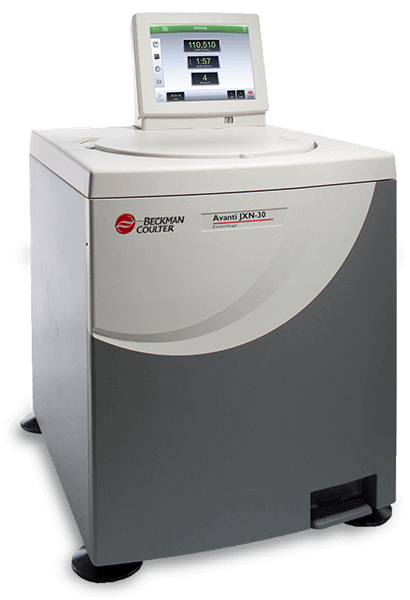
The maximum speed depends on the model and rotor configuration. Many high-speed centrifuges operate between 20,000 and 30,000 RPM and generate forces exceeding 80,000 × g, enabling efficient separation of biological particles and cellular components. The Avanti JXN-30 Centrifuge can generate forces up to 110,510 x g.
What is the difference between a high-speed centrifuge and an ultracentrifuge?
High-speed centrifuges are typically used for separating cells, organelles, and larger biomolecules, while ultracentrifuges achieve significantly higher speeds and centrifugal forces for applications involving viruses, extracellular vesicles, lipoproteins, nanoparticles, and other very small particles.
What is a high-speed centrifuge?
A high-speed centrifuge is a laboratory instrument that separates particles by applying centrifugal force at speeds typically ranging from 10,000 to 30,000 RPM, depending on the rotor and system used. High-speed centrifuges are commonly used for processing cells, proteins, bacteria, and other biological samples.
