
Zellzählung, Zellvitalitätsanalyse und Zellkonzentrationsmessung
Beckman Coulter Life Sciences bietet verschiedene Geräte zur Zellzählung, Zellvitalitätsbestimmung, Zellkonzentrationsmessung sowie zur Analyse diverse Bioanalyten.
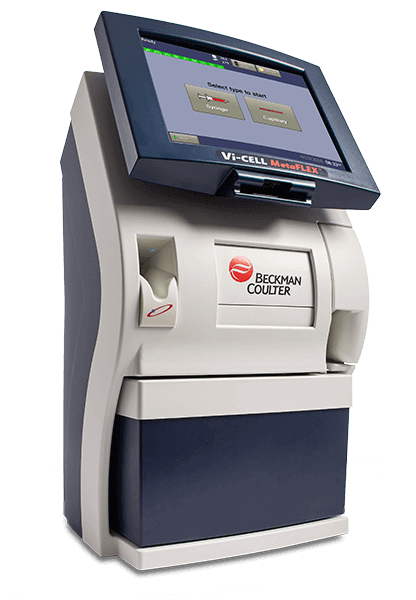
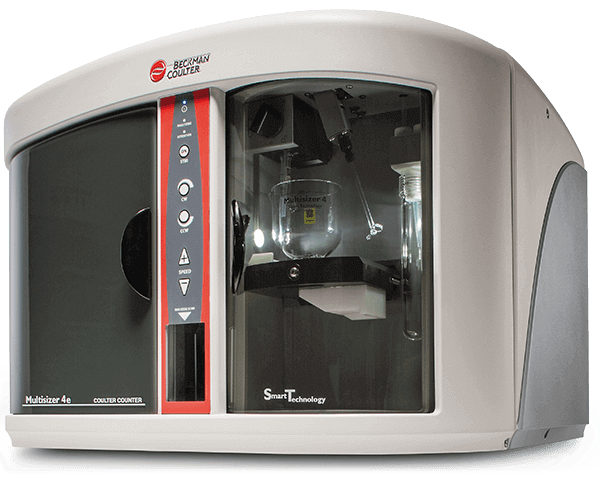
Durch die automatisierte Standard-Trypan-Blau-Methode bieten der Vi-CELL XR und der Vi-CELL BLU schnelle und präzise Daten und Analysen zur Zellzahl, Zellkonzentration und Zellgröße. Der Vi-CELL MetaFLEX vervollständigt die Vi-CELL-Familie und bietet schnelle und reproduzierbare Analysen von Bioanalyten in nur 35 Sekunden. Mit dem Multiszer 4e ist eine schnelle Zellzählung und Zellgrößenbestimmung Mittels dem Coulter-Prinzip möglich.
Alle Reagenzien zu unseren Produkten finden Sie hier

FAQ on Cell Counters, Sizers and Media Analyzers
What is a Coulter Counter?
A Coulter Counter counts and sizes particles suspended in an electrically conductive liquid by measuring changes in electrical impedance as individual particles pass through an aperture. Each detected pulse represents a particle event, while pulse amplitude is proportional to the volume of electrolyte displaced by the particle. When the analyzed sample volume is known, the measurements can also be used to determine particle concentration. The Multisizer 4e Coulter Counter applies this method to individual-particle counting and sizing.
The Coulter Principle is used to count and size particles suspended in an electrically conductive liquid. As particles pass individually through an aperture between two electrodes, each particle displaces electrolyte and produces a temporary change in electrical impedance. The number of pulses corresponds to the number of detected particles, and the amplitude of each pulse is proportional to particle volume. These data can be used to calculate particle size distribution and concentration.
When should a Coulter Counter be used instead of flow cytometry?
A Coulter Counter is appropriate when the primary objectives are to determine individual-particle count, concentration and volume-based size distribution without relying on fluorescent labels or particle optical properties. Samples must be suspended in an electrically conductive liquid and matched with an appropriate aperture.
Flow cytometry may be more appropriate when the study requires fluorescence-based identification, biomarker expression data or differentiation of populations using multiple optical parameters. Method selection should be based on the required information, sample characteristics and analytical workflow.
What factors can influence cell viability measurements?
Cell viability results can be affected by sample handling, incubation conditions, reagent selection, timing of analysis, and cell type. Standardized protocols help improve consistency and ensure reliable viability assessments across experiments.
